1. Know Exactly What You Have, at All Times
Running out of stock at the wrong moment, or over-ordering something you already have plenty of, almost always traces back to the same root cause: no reliable inventory schedule template in place. An inventory schedule template gives a business a single, up-to-date record of what has sold, what remains on the shelf, and what the projected closing balance looks like for each item, so reorder decisions are based on real numbers instead of a guess. Retailers, warehouses, and small business owners alike lean on this kind of document because inventory is often the single largest tied-up asset a company holds, and mismanaging it quietly drains cash flow in a way that is easy to miss until the damage is already done. Getting ahead of that problem starts with simply writing the numbers down in one consistent place, week after week.
2. Reorder Before You Hit the Minimum Stock Line
The real value of an inventory schedule template shows up at the reorder point — the moment stock drops low enough that a new order needs to go out before shelves actually run empty. Without a documented schedule, that decision usually gets made reactively, once a customer has already asked for something that is out of stock, which is the most expensive way to discover a shortage. An inventory schedule template flags this ahead of time by tracking sold quantity against remaining quantity for every stock item, department, or product line a business carries, whether that is for the whole company or broken down warehouse by warehouse. Businesses that review their inventory schedule on a fixed weekly or monthly cadence consistently report fewer stockouts and less emergency ordering at rush shipping rates, simply because the warning signs are visible early instead of showing up as a surprise.
3. Build Your First Inventory Schedule in Minutes
You do not need expensive inventory management software to get started — an editable inventory schedule template in a spreadsheet program is enough for most small and mid-sized operations. Begin by listing every stock item along with its current on-hand quantity, then add columns for units sold over the tracking period, the reorder threshold, and the expected closing balance once existing orders arrive. Updating the inventory schedule template at the same time every week keeps it accurate without becoming a burdensome task, and many businesses assign the update to whoever closes out sales for that period so it becomes part of an existing routine rather than an extra chore. Once the habit is established, this free, easily editable template scales from a single product line to an entire warehouse’s worth of stock with no extra cost.
Get Free Inventory schedule template Here
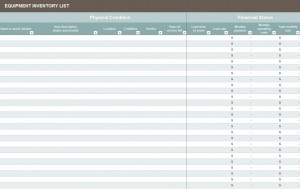
-

-
Title: Inventory schedule template Doc (2748 clicks)
Caption: Inventory schedule template
Filename: inventory-schedule-template-doc.xltx
Size: 56 KB

Frequently Asked Questions About the Inventory Schedule Template
What information belongs on an inventory schedule template?
At minimum it should list each stock item, the quantity currently on hand, units sold during the tracking period, and the reorder threshold that triggers a new purchase order. Many businesses also add supplier lead time so they know how far in advance to reorder before actually running out.
How often should an inventory schedule be updated?
Weekly is common for fast-moving retail stock, while monthly can work for slower-moving items or larger equipment. The right frequency depends on how quickly your stock levels change, but the inventory schedule template should be reviewed often enough that a shortage never comes as a surprise.
Can this template be used for more than one warehouse or department?
Yes, many businesses duplicate the inventory schedule template for each location or department and then compare them side by side, which makes it easier to spot whether a shortage in one location could be solved by transferring stock from another instead of placing a brand-new order.
Does the inventory schedule template help with forecasting future orders?
It does, since tracking sold quantity over several periods reveals patterns in demand that make future ordering far more predictable. Businesses that keep a consistent inventory schedule template over several months typically get noticeably better at anticipating seasonal spikes and slow periods.
Is this inventory schedule template suitable for a small business just starting out?
Absolutely — it is designed to be simple enough for a single owner-operator to maintain without any specialized training, while still being detailed enough to scale up as the business grows and the number of stock items increases.
What software do I need to use the template?
The inventory schedule template opens in standard spreadsheet software, so no additional purchase or installation is required beyond a program most computers already have.
Can the template help reduce excess or dead stock?
Yes. Seeing exactly how slowly certain items move compared to others makes it much easier to identify dead stock early and adjust future ordering, rather than discovering a shelf full of unsold inventory months later during a physical count.
Can the inventory schedule template be shared across a team?
Yes, many businesses keep it in a shared spreadsheet so warehouse staff, purchasing managers, and sales teams are all working from the same numbers. This avoids the common problem of one department ordering stock that another department has already reordered.
How is an inventory schedule different from a stock count?
A stock count is a one-time snapshot of what is physically on the shelf, while an inventory schedule template tracks that information continuously over time, including sales activity and reorder points, which makes it a planning tool rather than just a record.
What is the biggest mistake businesses make without an inventory schedule?
The most common mistake is reordering reactively, only after a customer asks for something that is already out of stock. An inventory schedule template flips this by surfacing the warning signs of a shortage while there is still time to act on them.
Is the inventory schedule template useful for seasonal businesses?
Yes, seasonal businesses benefit especially from keeping a historical inventory schedule from previous years, since it reveals exactly when demand for certain items typically spikes and allows ordering to be timed ahead of that pattern rather than reacting to it after sales have already started climbing.